When Does a Job Actually Require a Full-Size Excavator Instead of a Mini?
The honest answer is that depth alone rarely settles it. Most jobs that need a deep hole can be dug with a mini. The real question is what a mini costs you in time when the project grows beyond a certain scale, and whether the machine has the reach, bucket capacity, and raw weight to handle the work without turning a two-day job into a two-week one.
Excavator rental starts with knowing what the job actually demands. Here is how to read the situation correctly.
The Two Things a Full-Size Excavator Does That a Mini Cannot Match
A full-size excavator can offer up to twice the reach of a mini and up to five times the bucket capacity. Those numbers do not mean much in isolation, but on a large job they compound fast.
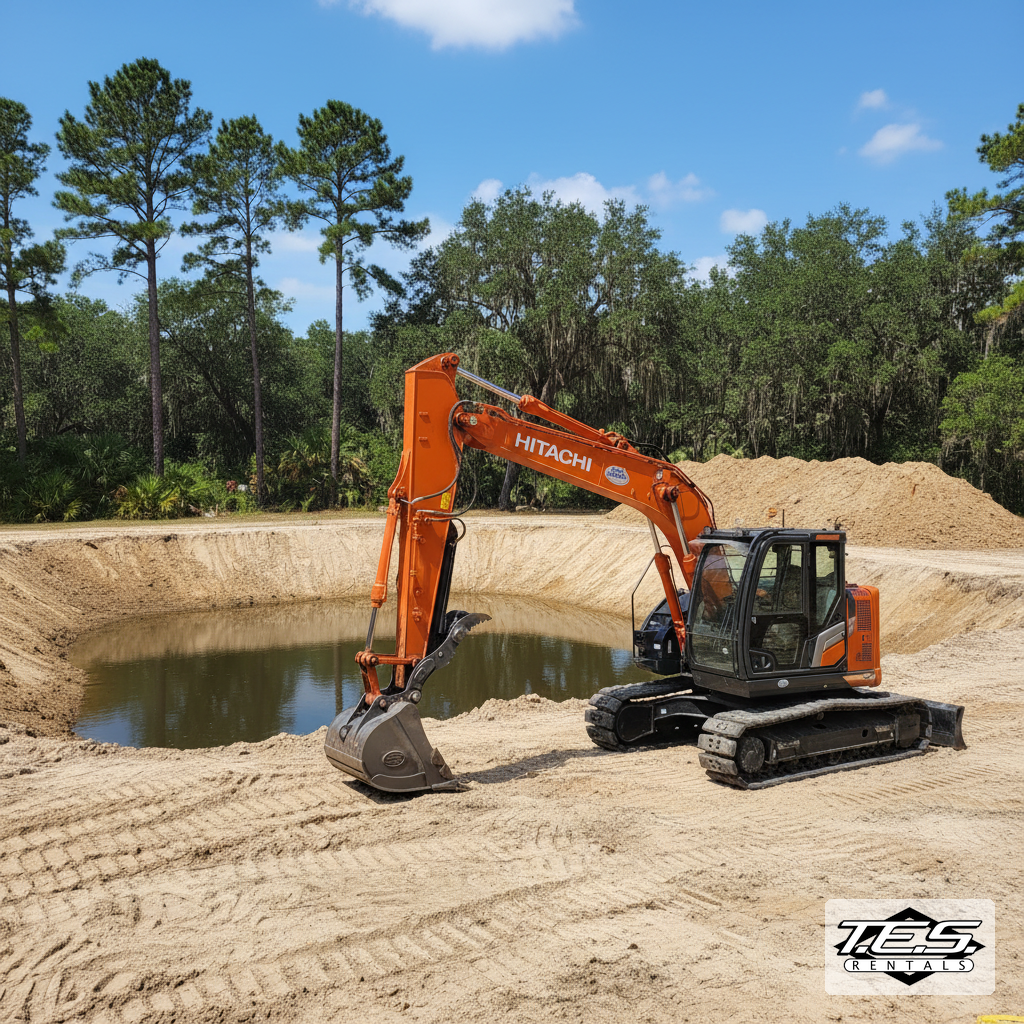
The clearest example is pond excavation. On a quarter-acre pond, a mini might technically reach the required depth. But the full-size covers far more ground per pass, and that difference turns what would be weeks of excavation into days. The math is not close. When you factor in extended rental days or overtime hours on the mini, the cheaper machine often ends up costing more in total.
The same principle applies to land clearing at scale. Clearing large tracts, pushing over large trees, and pulling stumps up directly all favor a machine with weight and power behind the bucket. With a full-size, you can reach out and push a tree over or pull a stump without digging extensively around the base first. That saves an enormous amount of time per tree when you are working through acreage.
When the Full-Size Is the Right Call
Large-scale excavation, including ponds. Once the project combines meaningful depth with significant surface area, the full-size is the practical choice. A quarter-acre pond is the common threshold in North Florida where this combination applies regularly. At that scale, the mini excavator rental option becomes a time liability.
Heavy land clearing and stump removal. The weight and power of the full-size allow direct push-and-pull removal on trees and stumps without as much preliminary digging. This matters even more in areas with shallow clay layers, which add resistance compared to sandy soils. Pine stumps with deep tap roots are harder to remove than oaks or sweet gums regardless of machine size, and the full-size handles them more efficiently.
Jobs that require additional machines on site. Large pond and excavation jobs often need a wheel loader, a dozer, or both to move excavated material away from the site. If the logistics already call for multiple machines, there is rarely a good argument for undersizing the primary excavator.
Matching Machine to Time Frame
It always comes down to time saved. Most contractors want the job done as quickly and efficiently as possible, and the right size machine is the one that meets your time frame without burning extra days on the rental.
If you come in torn between the two, there is no single question that settles it. The right call comes from looking at the job site, the end goal, and your time requirements together. Because we run every machine in nearly every job type, we size you to the same machine we would use in that situation.
Contractors usually know how to make this call. It is homeowners and property owners with limited experience who most often end up on the wrong machine. When someone is guided toward the full-size and it turns out to be more than the job needed, they finish faster than expected and feel like they overspent. That outcome is far better than the reverse: picking the mini, running long, and spending more between extended rental days and overtime hours than the full-size would have cost from the start.
Property owners near Starke, FL and Lake Butler, FL deal with this sizing question regularly on pond and land clearing projects, and the answer almost always comes back to scale and time.
FAQ
When does a full-size excavator make more sense than a mini on a pond job?
Once you are working on a quarter-acre pond or larger, the full-size becomes the practical choice. A mini may reach the depth, but the full-size’s reach and bucket capacity (up to 2x the reach and 5x the bucket capacity) turn weeks of work into days.
Does soil type affect whether I need the full-size for tree and stump removal?
Yes. Sandy soils make root systems easier to break free; shallow clay layers add resistance. Pine stumps with deep tap roots are harder to remove than oaks or sweet gums regardless of machine size, so on sites with heavy pine and clay, the full-size’s extra power matters more.
What other machines might I need alongside the full-size on a large excavation?
On larger pond and excavation jobs, you will often need a wheel loader, a dozer, or both to move material away from the site. Plan for that when you are budgeting the job.
Contact us to rent the right excavator for your job, and we will match you to the machine that fits your site and schedule.