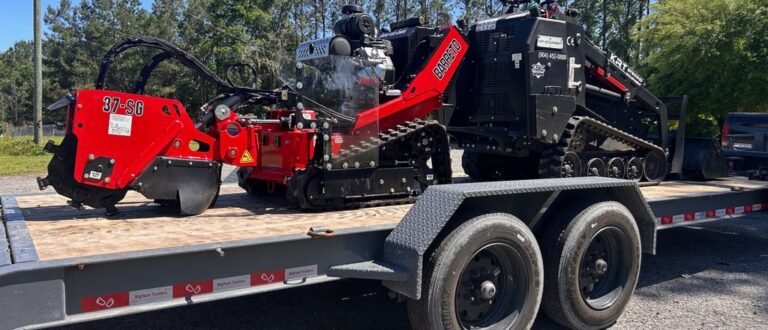
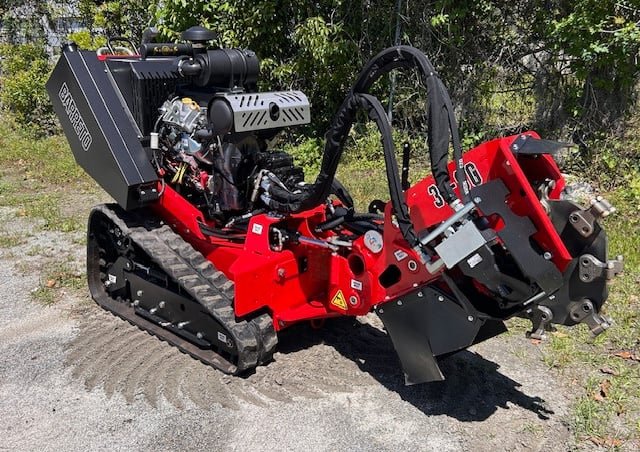
A stump grinder is the better choice when you need to remove tree stumps without excavating the surrounding area, making it ideal for tight spaces, landscaped yards, or when you want to preserve the soil structure and existing vegetation. Excavators, while capable of removing stumps by uprooting, are more expensive to operate, require more space to maneuver, and leave large holes that require backfilling and grading.
Choosing between a stump grinder and an excavator depends primarily on your site constraints and what you plan to do with the remaining space, but stump grinders offer a cost-effective, efficient solution for most residential and small commercial stump removal jobs in North Florida.
Need help deciding? Call us at (904) 452-0888 or fill out our project inquiry form at tesrents.com.
Why People Choose Excavators for Stumps
When customers see a large stump, the instinct is often to dig it out.
Common assumptions:
A bigger machine will be faster
Multiple small stumps will be quicker to dig than grind
The stump is “gone” once it’s out of the ground
What’s usually overlooked is everything that comes after the stump is removed.
Where Excavators Fall Short for Stump Removal
An excavator can remove a stump quickly but the job doesn’t end there.
In real-world jobs, customers often underestimate:
Time required to dispose of the stump
Backfilling the hole with imported material
Leveling and repairing disturbed ground
Track damage to surrounding turf or landscaping
Once cleanup and restoration are added, digging often becomes far less efficient than expected.
Where Stump Grinders Clearly Win
Stump grinders are best suited for:
Residential yards
Stumps near homes or foundations
Areas where roots run under utilities or concrete
Jobs where finished appearance matters
Grinding removes the stump without creating a large hole, which dramatically reduces follow-up work.
Florida Soil & Backfill Considerations
Florida’s sandy soil and lack of rock make stump grinding especially effective.
Best practice we’ve seen:
Grind the stump and roots
Use the ground material to backfill the void
Compact the area with the machine
Slightly mound the surface to allow for natural settling as material decomposes
This method usually leaves a mostly level surface over time with minimal disturbance.
Surface Damage & Cleanup Reality
There’s a clear difference between the two methods.
Excavators typically cause more surface damage, especially on larger stumps
Tracks disturb turf, and digging expands the affected area
Stump grinders keep work localized to the stump itself
When finished appearance matters, grinding almost always leaves the site in better condition.
DIY Homeowner Takeaways
DIY customers often lean toward excavators because they’re familiar and versatile.
What’s often missed:
Post-removal cleanup takes more time than expected
Backfilling and leveling add work and cost
A single stump can turn into a multi-day project
For most homeowners, stump grinders reduce complexity and effort.
Contractor Notes
Arborists are the primary users of stump grinders.
Their decisions are usually based on:
Customer preference for minimal disturbance
Time efficiency
Finished appearance
Excavators are chosen when:
Disturbance isn’t a concern
Multiple tasks will be completed with the same machine
Land is being cleared rather than restored
Time & Efficiency Reality
In practice:
Excavators may remove the stump quickly but add time afterward
Efficiency is measured by total job time, not just removal speed
When restoration is factored in, grinders usually win.
When an Excavator Is the Right Tool
Excavators make sense when:
Finished appearance does not matter
Organic material is being removed or burned
Multiple large stumps are involved
The excavator will be used for additional work during the same rental
This is common in land clearing or early-stage construction projects.
Cost, Risk, and Planning Notes
Stump grinding often saves money when:
The rental cost is less than hiring a contractor
Only one or a few stumps are involved
Property restoration is important
Grinding may not make sense when:
The land is being fully cleared for a structure
Appearance and ground disturbance are not concerns
Choosing the right tool upfront avoids wasted effort and unnecessary site repair.
Our Rule of Thumb
If the goal is to remove a stump with the least amount of disturbance, a stump grinder is usually the better choice.If the goal is to remove standing trees or as many stumps as possible with no regard for disturbance, an excavator makes more sense.
Frequently Asked Questions About Stump Grinding vs Excavation
Is it faster to dig out a stump with an excavator?
Only for the removal itself. Once cleanup, disposal, and site repair are included, stump grinding is usually faster overall.
Does stump grinding remove the entire stump?
Grinding removes the stump and major roots below grade. Remaining material decomposes naturally over time.
Will grinding leave a hole in my yard?
No large hole. The ground material is typically used to backfill the area, which settles gradually.
When should I avoid stump grinding?
When the land is being cleared entirely or when ground disturbance is not a concern.
Internal Links
Next Step
If you’re deciding between grinding or digging a stump, the right choice depends on your end goal not just the size of the stump. Talking through the project details with us upfront usually saves time and unnecessary work later.
Let us help you figure it out. Call us at (904) 452-0888 or fill out our project inquiry form at tesrents.com.
Zeb is the owner of T.E.S. Rentals in Starke, FL. With nearly 2 decades in the industry he helps North Florida contractors and property owners choose the right equipment for land clearing, excavation, and property work.